







Important Design Characteristics for Selecting Your First RC Plane
Posted: 11/1/18
Knowing design characteristics that affect how an airplane will fly can help you feel confident when selecting your first RC plane. After reviewing the basics below, you should have a good idea of the design characteristics you will want in your first plane. Each individual aircraft will require specific accessories to build and fly the model properly.
Aerodynamics
To fly, an airplane's wing has to overcome gravity by developing lift greater than the weight of the plane. Since it can't do that standing still, airplanes use thrust (force directed backwards) to drive the wing forward through the air and generate lift. However, thrust has its own opposition to overcome in the form of drag—the resistance of the air to a body moving through it. If lift and thrust are greater than gravity and drag, you have the potential for flight…and fun!
Wing Location
Wing placement, for the most part, falls into two major categories — high wing design and low wing design. In a high wing design, the weight of the model is suspended below the wing. When the model tilts, the model's weight tries to return it to a level position. As a result, high-wing models tend to be more stable, easier to fly—and natural choices for trainers. A low-wing model is just the opposite. With its weight above the wing, it tends to be less stable— excellent for advanced fliers who want to perform rolls, loops and other aerobatic maneuvers.
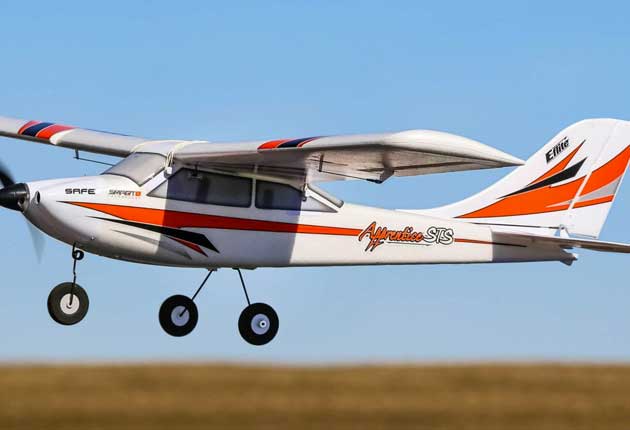
E-Flite Apprentice STS 1.5m has a high wing design for stable flight.
Airfoil
If you face the wing tip of the plane and cut it from front to back, the cross section exposed would be the wing's airfoil. The Flat-Bottom Airfoil will develop the most lift at low speeds and helps return the model to upright when tilted. This is ideal for trainers and first-time pilots. A Symmetrical Airfoil's top and bottom have the same shape, allowing it to produce lift equally whether right side up or upside down and to transition between the two smoothly (this is recommended for advanced pilots). Lastly, a Semi-Symmetrical Airfoil is a combination of the other two and favored by intermediate and sport pilots.
Wing Area/Wing Loading
Wing area is the amount of wing surface available to create lift. Wing loading is the weight that a given area of the wing has to lift and is usually measured in ounces per square foot. Generally, a light wing loading is best for beginners. The plane will perform better and be easier to control.
Dihedral
Dihedral is the upward angle of the wings from the fuselage. Dihedral increases stability and decreases aerobatic ability.
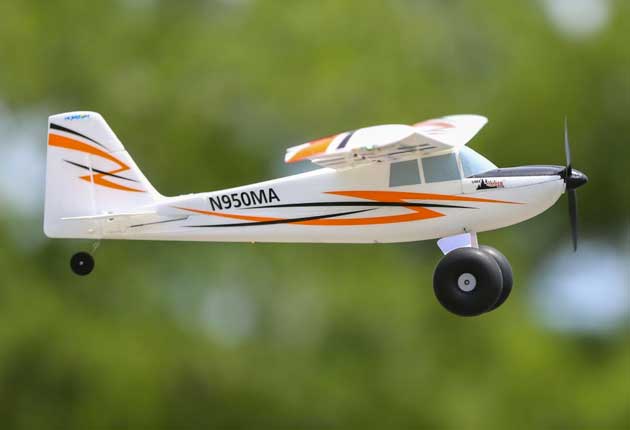
E-Flite UMX Timber has a nominal dihedral for stable flight.
Wing Thickness
Wing thickness, measured from top to bottom, determines how much drag is created. A thick wing creates more drag, causing slower speeds, gentler stalls, and is ideal for beginners. A thin wing permits higher speeds and sudden stalls — desirable for racing and certain aerobatic maneuvers.
Landing Gear Location
Tricycle gear includes a nose gear and two wing (main) gears, making takeoffs and landings easier—ideal for beginners. Tail draggers have the two main gears towards the front and a smaller “Tail wheel” that is back by the rudder. In general a taildragger takes additional experience and time to master.
Related Articles

Acronyms and Assembling of RC Airplanes: From Kits to RTF
There are many acronyms in RC aviation, including the ones that signify how much assembly will be required for your RC airplane. We'll explain everything from RC airplane Kits to RTF here.
Learn More

Best Tools for RC Boaters
Find the best tools for RC boaters to have your toolbox ready for your next RC boating adventure.
Learn More

HobbyZone Mini AeroScout - Horizon Insider All In One Box
Kyle Roberts shows us how the HobbyZone Mini AeroScout has everything needed to get you airborne out-of-the-box.
Learn More